
2026 Tax Year
Live
—
Pennsylvania
LIVE
--°
Loading…
If you live in one of these states and work in the other, a decades-old reciprocal tax agreement means only one state ever taxes your wages — and it's almost always cheaper to be the Pennsylvania side of that equation. This guide explains exactly how the PA–NJ reciprocity agreement works, where it doesn't apply, and how to make sure your employer is withholding the right state's tax. For your own paycheck numbers, run them through the Pennsylvania Paycheck Calculator on the homepage.
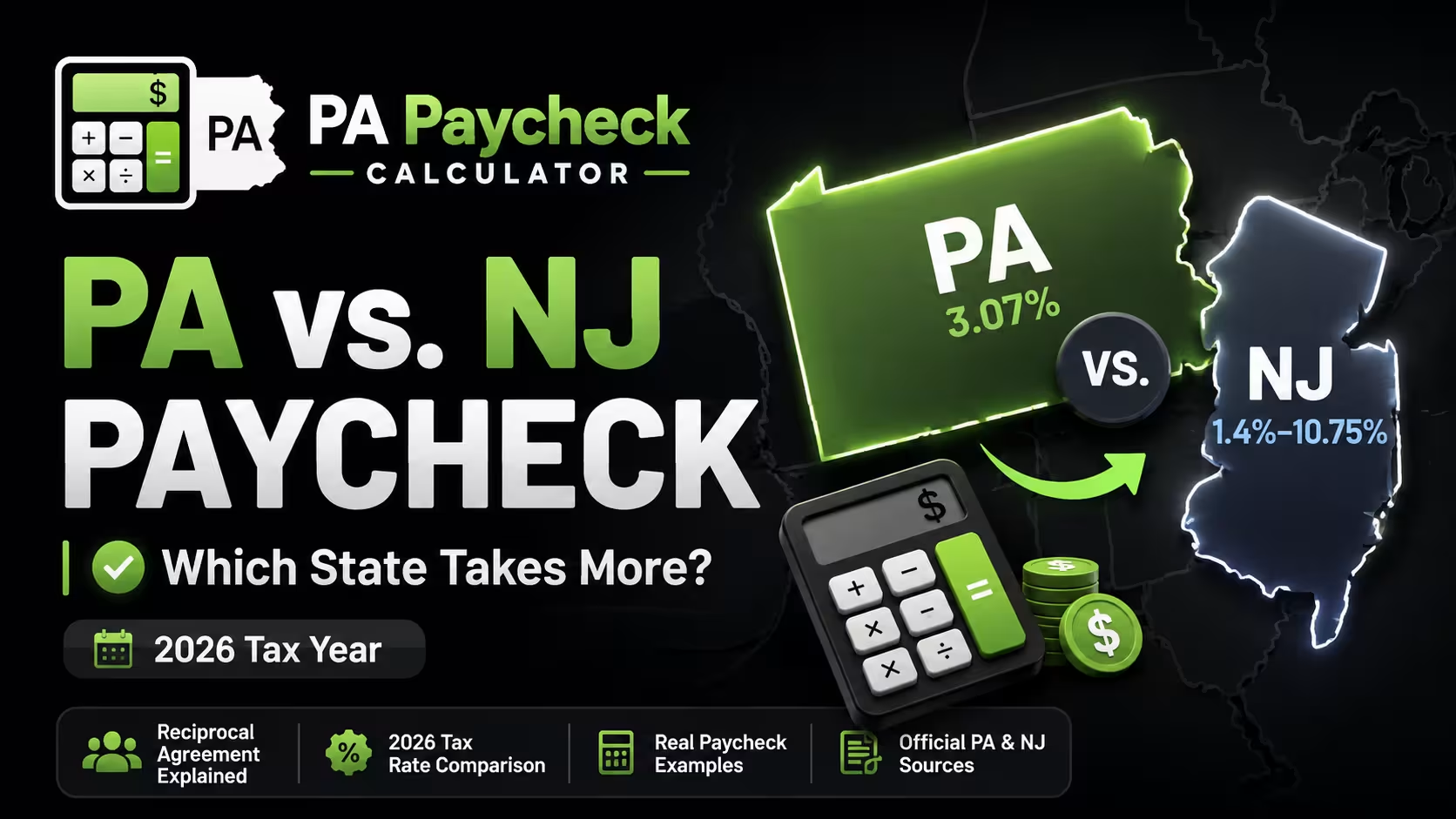
Quick answer: Thanks to the PA–NJ Reciprocal Personal Income Tax Agreement, you only pay income tax to the state where you live, not the state where you work — as long as your income is wages from an employer. Since Pennsylvania's flat 3.07% rate is lower than nearly every New Jersey bracket above the lowest, a Pennsylvania resident commuting into New Jersey almost always comes out ahead of a New Jersey resident commuting into Pennsylvania, income tax alone considered. The one major exception: Philadelphia's city Wage Tax still applies regardless of the state agreement.
Pennsylvania and New Jersey have maintained a reciprocal personal income tax agreement since 1977. It's a simple rule with a big effect for the roughly quarter-million people who cross the Delaware River for work each day: your wages are taxed only by your home state, never by the state where your office sits.
Your wages are subject to Pennsylvania's flat 3.07% income tax only. New Jersey should not withhold any state income tax from your paycheck, regardless of your NJ work location.
Your wages are subject to New Jersey's graduated income tax only (1.4%–10.75%). Pennsylvania should not withhold state income tax from your paycheck.
The agreement applies to salaries, wages, tips, fees, commissions, and bonuses from an employer. It does not cover self-employment income, business profits, rental income, or capital gains — those can be taxable in both states.
Pennsylvania's simplicity is its biggest advantage: one flat rate, no brackets. New Jersey's system is graduated across seven brackets, so your effective rate depends heavily on total income.
| Filer Type | Pennsylvania | New Jersey |
|---|---|---|
| Structure | Flat rate | Graduated, 7 brackets |
| Rate on first $20,000 | 3.07% | 1.4% |
| Rate around $50,000–$75,000 | 3.07% | 5.525% |
| Rate around $100,000–$500,000 | 3.07% | 6.37% |
| Rate $500,000–$1,000,000 | 3.07% | 8.97% |
| Top rate (above $1,000,000) | 3.07% | 10.75% |
| State standard deduction | None | None (uses personal exemptions) |
Rates shown are state income tax only — they exclude federal tax, FICA, and any local or city tax such as Philadelphia's Wage Tax. New Jersey's lowest bracket (1.4%) is actually below Pennsylvania's flat rate, so very low earners see a small edge living in NJ; that advantage disappears quickly once income crosses roughly $35,000–$40,000.
Say two people each earn a $75,000 salary and commute across the state line for work. Here's how their state income tax alone compares, before any local tax, federal tax, or FICA.
| Scenario | State Tax Owed |
|---|---|
| Lives in PA, works in NJ — taxed by PA at flat 3.07% | ≈ $2,303 |
| Lives in NJ, works in PA — taxed by NJ graduated brackets | ≈ $2,730 |
Illustrative estimate on $75,000 of taxable wages, ignoring deductions and exemptions on both sides. The gap widens considerably at higher incomes, since New Jersey's marginal rate keeps climbing while Pennsylvania's stays flat at 3.07% no matter what you earn. Run your own numbers through the Pennsylvania Paycheck Calculator for a precise PA-side estimate.
This is the detail that trips up the most commuters. The PA–NJ agreement only covers state income tax. It has no effect on city or municipal taxes — and Philadelphia runs its own Wage Tax completely separate from Pennsylvania's state system.
If you're a New Jersey resident who works in Philadelphia, you still owe the Philadelphia Wage Tax (3.75% for residents' rate; a lower non-resident rate applies to Philadelphia workers who live outside the city) — the reciprocal agreement does not exempt you from it. New Jersey does allow you to claim a credit on your NJ return for Wage Tax paid to Philadelphia, but you'll need to file that credit yourself; it isn't automatic. See our Philadelphia paycheck calculator to estimate that city-specific withholding.
Outside Philadelphia, most other Pennsylvania municipalities' local Earned Income Tax (EIT) only applies to PA residents — so a New Jersey resident commuting into Pittsburgh or Allentown, for example, generally isn't subject to that municipality's EIT the way a PA-resident coworker would be. Philadelphia's Wage Tax is the outlier precisely because it applies based on where you work, not just where you live.
Employers sometimes default to withholding tax for the state where your job is located, even when the reciprocal agreement says they shouldn't. If that's happening to you, here's how to fix it going forward.
PA resident working in NJ: Give your employer a completed Form NJ-165, Employee's Certificate of Non-Residence in New Jersey, to stop New Jersey withholding. You'll still need to file a one-time NJ nonresident return to recover any tax already withheld before the form took effect.
NJ resident working in PA: Give your employer Form REV-419, Employee's Nonwithholding Application Certificate, to stop Pennsylvania withholding. File a PA nonresident return to get back anything already withheld.
Either direction, if tax was already withheld: You'll need to file a nonresident return in the state that wrongly withheld, claiming the reciprocal exemption, to receive a refund. Keep copies of both states' returns and your W-2 in case of an audit request.
Every figure and rule in this guide is drawn from the following official state sources. Confirm your own situation directly with these agencies before filing.