
2026 Tax Year
Live
—
Pennsylvania
LIVE
--°
Loading…
Pennsylvania taxes 401(k) contributions the moment they leave your paycheck — the opposite of how the federal government treats them. But Pennsylvania generally does not tax qualified 401(k) withdrawals once you reach retirement age. This guide explains exactly when each rule applies, using Pennsylvania Department of Revenue guidance. To see how your own contribution amount affects your paycheck today, use the Pennsylvania Paycheck Calculator on the homepage.
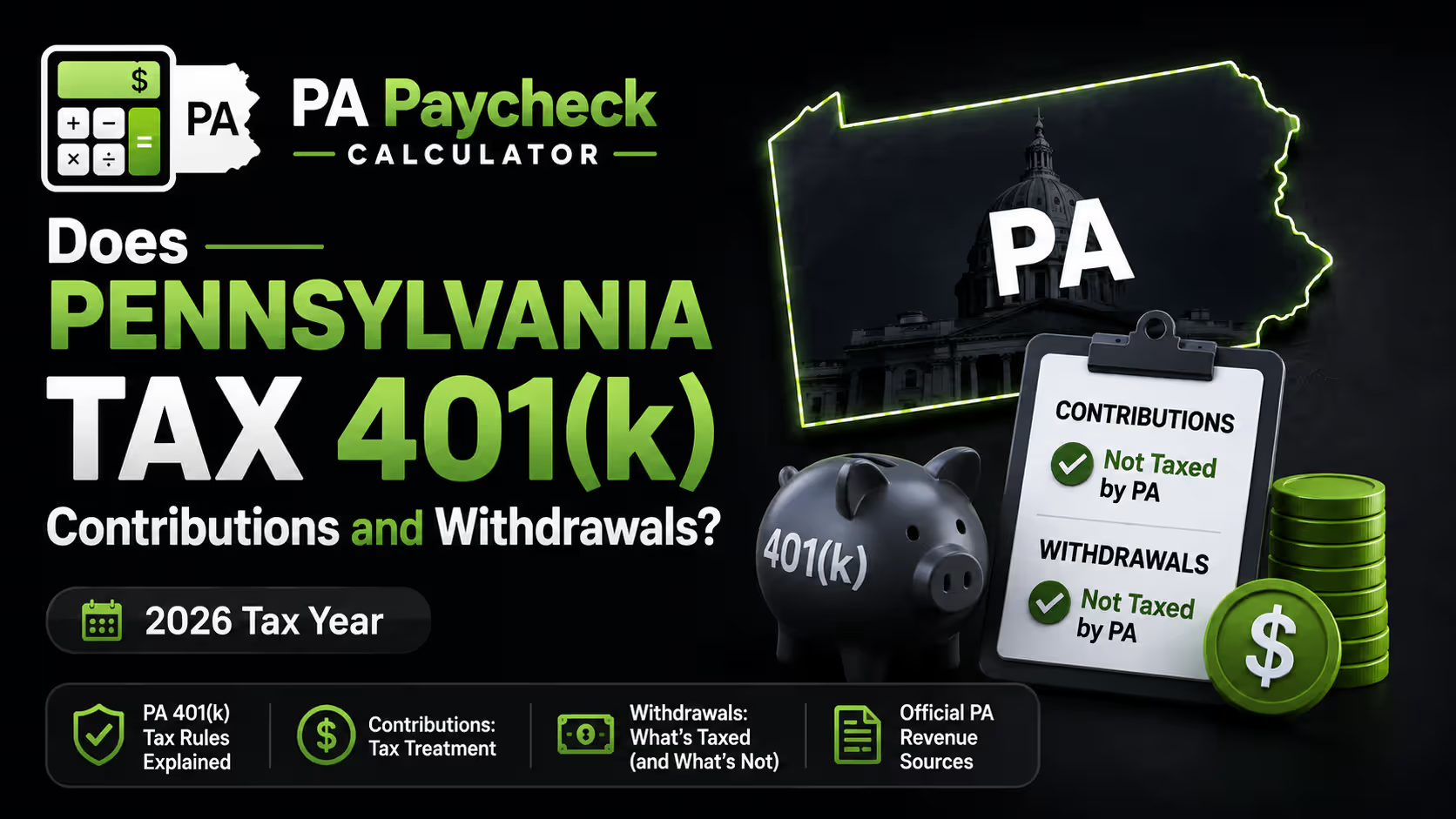
Quick answer: Yes, Pennsylvania taxes 401(k) contributions — both traditional and Roth — at the flat 3.07% rate when the money is contributed, since PA does not allow the federal pre-tax exclusion for traditional 401(k) deferrals. The good news comes later: once you reach your plan's retirement age (typically 59½ or your plan's normal retirement age) and take a qualified distribution, Pennsylvania generally does not tax that withdrawal at all — for either traditional or Roth accounts. Early withdrawals taken before meeting retirement age can still be taxable.
At the federal level, a traditional 401(k) contribution reduces your taxable wages for that year — you don't pay federal income tax on that money until you eventually withdraw it. Pennsylvania doesn't follow this treatment. Under Pennsylvania's personal income tax rules, elective deferrals to a 401(k) are included in "gross compensation" and taxed at the state's flat 3.07% rate in the year they're contributed, regardless of whether the contribution is traditional or Roth.
Traditional 401(k) contributions reduce your federal taxable wages now; you pay federal tax when you withdraw. Roth contributions are taxed now federally, tax-free later.
Both traditional and Roth 401(k) contributions are taxed by PA at 3.07% in the year contributed — PA does not recognize the traditional 401(k)'s pre-tax federal treatment.
Because PA taxes the contribution upfront, it generally does not tax the qualified withdrawal later — effectively giving 401(k) money "Roth-like" treatment at the state level, even for traditional accounts.
Generally, no — as long as the withdrawal counts as retirement income under Pennsylvania's rules. Since you already paid PA tax on the contributions, the state doesn't tax the money again when it comes back out, provided you've met your plan's retirement-age requirements.
| Situation | PA State Tax Treatment |
|---|---|
| Distribution after reaching retirement age (typically 59½ or plan's normal retirement age) | Generally not taxed |
| Required Minimum Distributions (RMDs) after retirement age | Generally not taxed |
| Early withdrawal, before meeting retirement age | May be taxable as compensation |
| Hardship withdrawal before retirement age | May be taxable, depending on source of funds |
| Rollover to another qualified plan or IRA | Not a taxable event |
This reflects Pennsylvania's general treatment of retirement plan distributions under its personal income tax rules. Individual circumstances — such as which portion of a withdrawal represents already-taxed contributions versus investment growth — can affect the exact taxable amount for early withdrawals. Confirm your specific situation with the PA Department of Revenue or a tax professional.
Here's how a $3,600 annual traditional 401(k) contribution (6% of a $60,000 salary) is treated differently at the federal and Pennsylvania level, before any other deductions.
| Layer | Taxable Wages |
|---|---|
| Federal taxable wages | $56,400 (contribution excluded) |
| Pennsylvania taxable wages | $60,000 (contribution included) |
| Extra PA state tax paid on the contribution now (3.07% × $3,600) | ≈ $111 |
| PA state tax owed on this money at qualified withdrawal in retirement | $0 |
Illustrative estimate only. The roughly $111 in additional PA tax paid today is generally the last state tax that $3,600 (plus any investment growth on it) will ever owe to Pennsylvania, assuming it's withdrawn as a qualified retirement distribution later. Use the Benefits tab on the Pennsylvania Paycheck Calculator to see this reflected in your own paycheck.
For federal tax purposes, the traditional-versus-Roth decision is significant — it determines whether you get the tax break now or later. For Pennsylvania state tax purposes, the two options land in almost the same place: both are taxed at contribution, and both are generally untaxed at qualified withdrawal.
That means the traditional-vs-Roth decision for Pennsylvania residents mostly comes down to your federal tax situation and expectations about future federal tax rates, not anything state-specific — Pennsylvania's flat 3.07% rate treats both the same way at both ends of the transaction.
This guide is based on the following official Pennsylvania Department of Revenue guidance. Confirm your specific situation directly with these sources before making retirement or filing decisions.
 By
By